
|
Wendelstein ObservatoryUniversity observatory MünchenFaculty for physics of Ludwig-Maximilians-Universität |


|
Site descriptionThe Wendelstein Observatory is situated on the summit of Mount Wendelstein, a prominent, 1838 m high mountain in the bavarian Alpes. It is operated by the University Observatory of the University of Munich.
Only 75 km south-east of Munich, after one hour care drive this site can
easily be reached via cable car (8 min) or by means of a cog rail road
(25 min.). Final access to the very top is achieved by an elevator
climbing up 100 m within the mountain. The observatory was first installed
to survey the solar activity. In the mid-1980, it was redirected to night
observations of stars and galaxies, but it still owns a
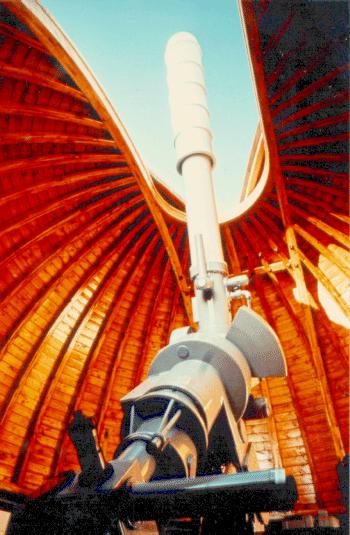
20 cm Zeiss solar coronograph.
Nowadays, the coronograph is used only for eduction and public outreach.
For first the night time activites, an 80 cm DFM-telescope
was installed which was operated until spring 2008 for scientific observing
programs every clear night. It was equipped with high-tech focal
instruments like high-speed multichannel photometers or a direct
imaging CCD-Camera. This instrumentation has often been involved
in international observing programs since. The scientific focussed
started with stars, especially binary stars. Later on, galaxies were added.
In 2007, a 40 cm telescope
was installed to bridge the gap for the students lab until
a 2.1 m telescope
took over on the old site of the 80 cm telescope. The pier and dome of
the 80 cm telescope have been demolished and replaced by a new building
with an 8.5m Baader dome (2010).
The new 2.1 m telescope was installed shortly before chrismas
2011 and went into regular observations mid 2013. It offers up to
four instruments. The science focus ranges from exo-solar planets, star
formation regions, nearby galaxies towards distant cluster of galaxies.
Its observing program reflects the scientific topics of the astronomer
groups at the university observatory
of the faculty of physics which is part of the Ludwig-Maximilians-University in Munich.
In 2016, the 40 cm telescope was shipped to the Munich host institute and a 43 cm Planewave astrograph was mounted in the 3.2m Baader dome. The new instrument continues the student lab support and offers a wider field of view. 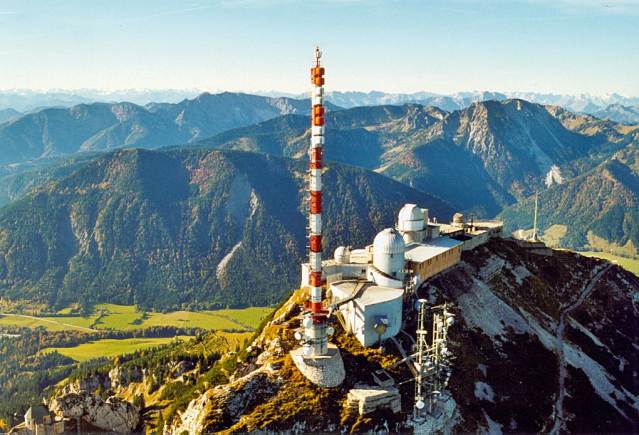
Meteorological Conditions:The weather conditions at Wendelstein are highly seasonal with sometimes more than 1m of snow in winter time and decent warmth in summer. But cold weather may occur at any time of the year.  Above the clouds at sunset
Compared to other sites in Germany the meteorological conditions at
Wendelstein have turned out to be fairly good. During typical years
about 120 nights with less than 2/8 cloud cover can be used for
astronomical observations. Extremely dark nights often occur in
autumn when the upper cloud layers may reach altitudes of 1500 - 1800
m thus preventing light pollution by some nearby small villages. Seeing conditions have been studied
in April through December 1998 using a copy of the ESO Paranal Seeing
Monitor kindly made available by ESO. (e.g. ESO La Silla and Paranal
in Chile,
Calar Alto
in Spain).
Telescope and Instrumentation:The 2.1 m Fraunhofer telescopeThe telescope was installed during the second half of 2011 by Kayser-Threde GmbH (München, meanwhile OHB Systems Wessling bei München) and Astelco System GmbH (Martinsried). A 8.5 m diameter dome of Baader Planetarium (Mammendorf) protects the telecope again bad weather conditions. The three mirrors of the telecope were produced by Lytkarino Opical Glass Factory (LZOS, Moskau). Its control system was designed and produced by tau-tec GmbH Tübingen entwickelt. . Instruments were build at the university observatory in Munich. The telecope has a compact Ritchey-Chrétien design with a free aperture of 2.1 meters and a focal ratio of f/7.8. The incoming light is redirected by a movable third plane mirror to one of the two Nasmyth-focal stations. At those stations, scientific equipment of up to 350 kg and a flat field of view of up to über 0.7 degree can be mounted. One station operates an optical CCD-based wide field imager making full use of this large field of view , the other one supports some field of view instruments without additional lens systems. The telescope can be opearted remotely. The scientific instruments build at the host institute in Munich:
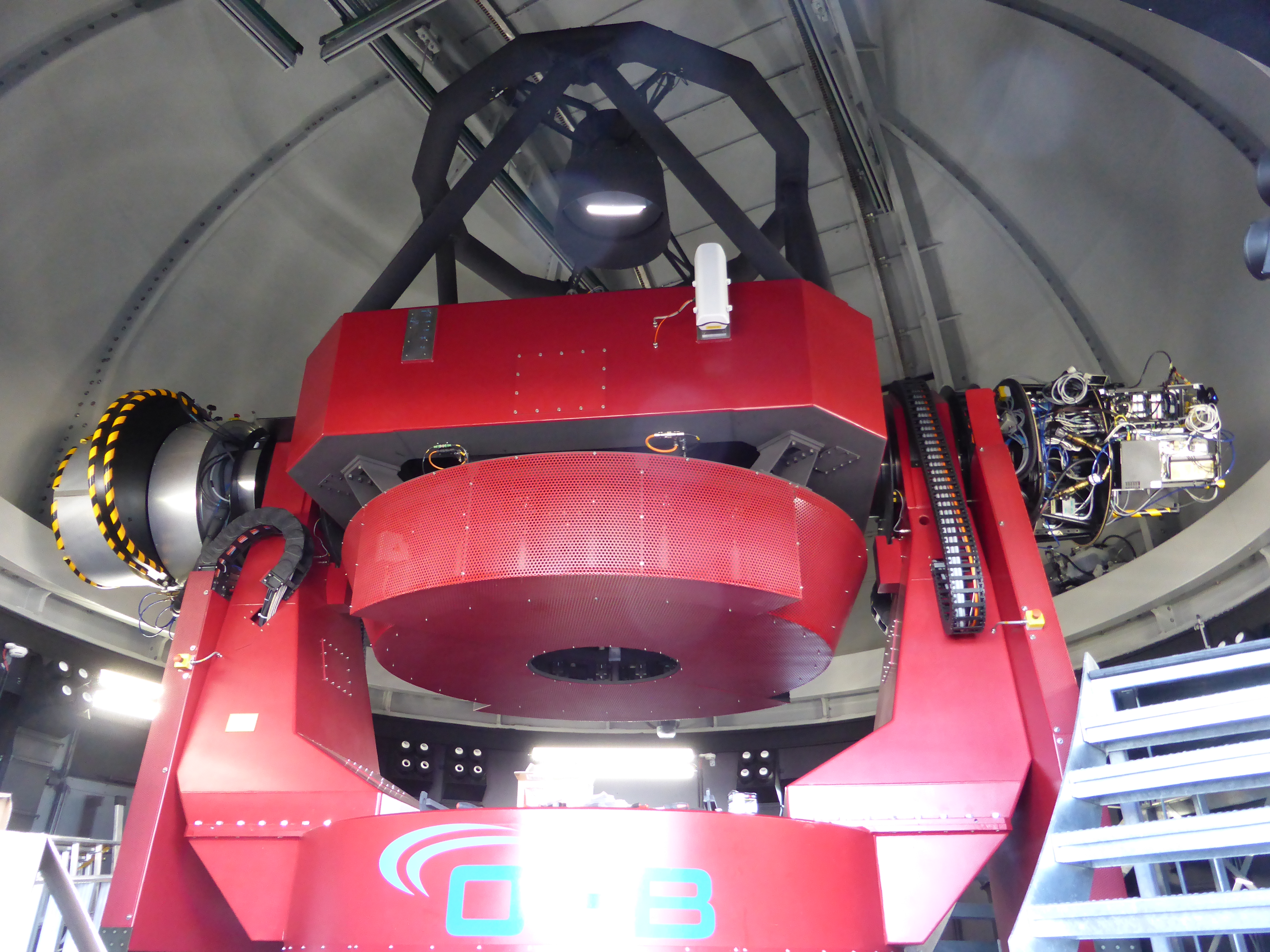
Wendelstein 2.1 m Fraunhofer telescope dbuild by Kayser-Threde (München) and Astelco (Martinsried) equipped with the wide field CCD camera WWFI (left) and the optical-near-infrared 3-chanal-camera (right). 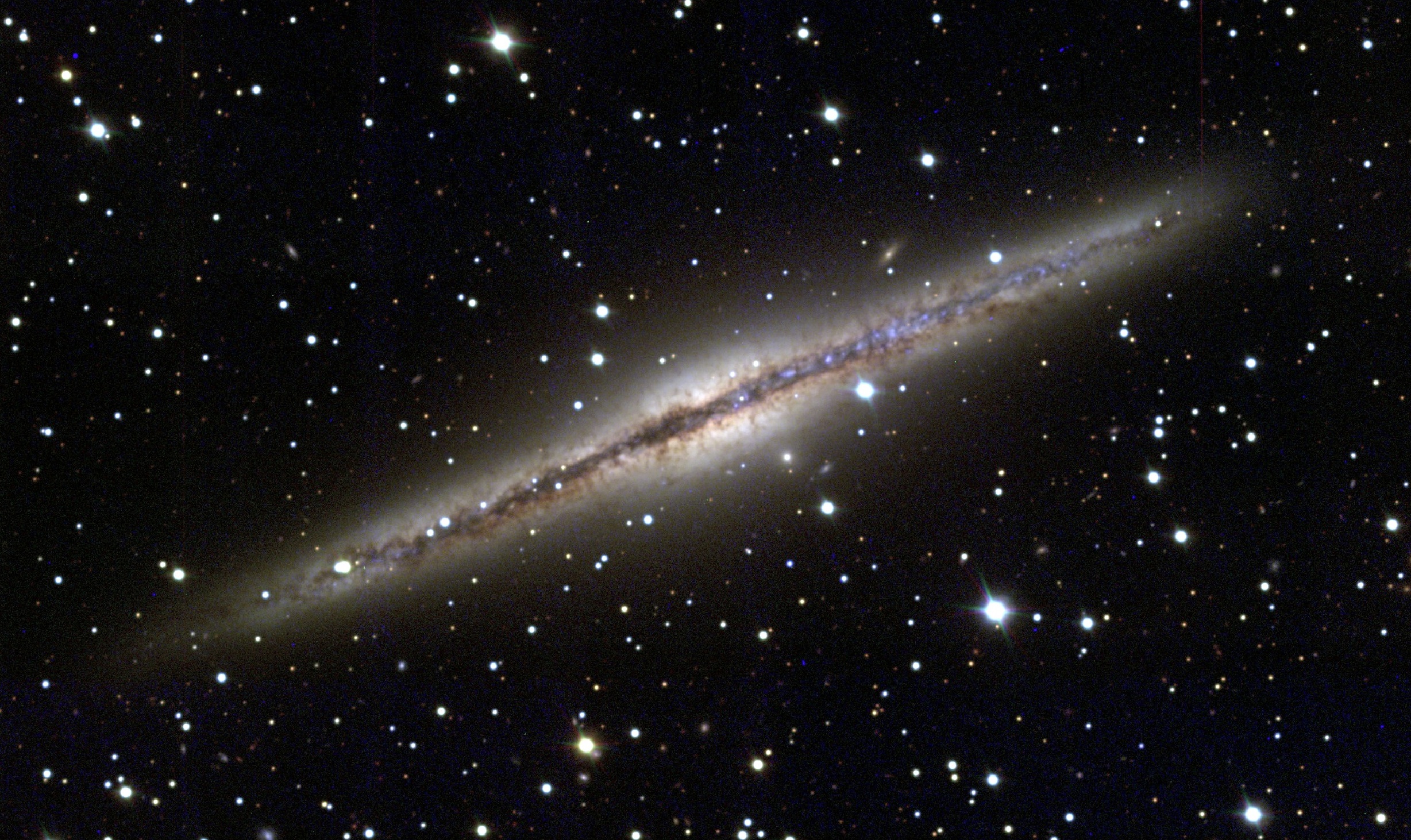
Exposure of the spiral galaxy NGC 891 (Andromeda) taken with the Wendelstein 2.1 m Fraunhofer Telescope and its WWFI camera. Individual exposures in u′, g′, und r′ filters were combied to a so-called true-color image. NGC 891 resembles our own Milky Way galaxy in size and structure and is about 30 Mio. lightyears away.
43 cm TeleskopSince 2017, a CDK17-Planewave telescope with a corrector for 0.75 degree field of view is operated in the small 3.2 m Baader dome and a CCD camera for imaging is mounted. The telescope is designed as a Dall-Kirkham astrograph. The telecope can be controlled remotely. Besides its imaging capability, it can also serve a small spectrograph for student lab work.
20 cm CoronographA special 20 cm refracor, built by Zeiss-Oberkochen, was used until 1988 to observe the activity of the sun in white light, Haplha, and spectra. On can place special light stops (the so-called coronographic design which produces artificial solar eclipses) into the telecope light path allowing to observe the solar atmosphere under excellent atmospheric conditions. The telescope is still used for public outreach and student eduction. Solar activity data taken at Wendelstein have been digitzed for the years 1947 to 1982 and are availabel from the Solar Data Services of the National Geophysical Data Center (Boulder).
Observing ProgramsThe telescopes at Wendelstein support the science topics of the astronomers of the university observatory in Munich which range from the exo-solar planets towards distant cluster of galaxies. Results can be found in the publication list of the observatory, which also includes the results of student work (OhD, master/diploma, bachelor). The telscopes also support the education of the Munich students.
Wendelstein live! (The observatory webcam)Landscape image galleryHistory(in German, many pictures)Publications, dissertations and diploma thesis'sBack to the main page of the University Observatory Munich |








|
Impressum --- Datenschutzerklärung Physik Datenschutzerklärung LMU |